In short: An acne mark is a flat colour change in the skin. It can appear as a red, pink, purple or brown mark left behind after a pimple heals.
An acne scar is a change in skin texture: a depression (ice-pick, boxcar, rolling) or raised tissue (hypertrophic, keloid). Marks often fade on their own with time, sun protection and the right skincare. However, true scars usually need a procedure. Telling the two apart: by touch, not just by eye, is the first step to treating them successfully.
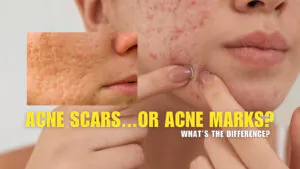
If you’ve ever looked in the mirror after a breakout and wondered “is this a scar, or just a mark?”, you’re not alone. The two get used interchangeably, but they’re different problems with different fixes.
What Are Acne Marks?
Acne marks are colour changes left behind after a lesion heals. No dip, no bump, just a flat patch that looks different from the surrounding skin. The most common type is post-inflammatory hyperpigmentation (PIH): inflammation from acne triggers extra melanin production, leaving a brown or darker mark. This is especially common and noticeable in medium-to-dark skin tones.
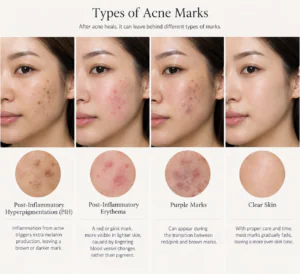
There’s also post-inflammatory erythema. This can be a red or pink mark, more visible in lighter skin, caused by lingering blood vessel changes rather than pigment.
- Red or pink marks after acne inflammation are called post-inflammatory erythema
- Brown or darker marks are post-inflammatory hyperpigmentation marks
- Purple marks. These can appear during the transition between the two
The defining feature of a mark, regardless of colour, is that the skin stays flat. According to the American Academy of Dermatology (AAD), a mildly darker spot usually fades within 6 to 12 months, though deeper discolouration can take years without treatment.
What Are Acne Scars? (Ice-Pick, Boxcar, Rolling, Hypertrophic & Keloid)
Acne scars are different. When inflammation from the acne has damaged deeper skin structures and disrupted original collagen architecture of the skin, the repair process leaves a lasting change in texture, not just colour. Most acne scars are atrophic (depressed), falling into three main types:
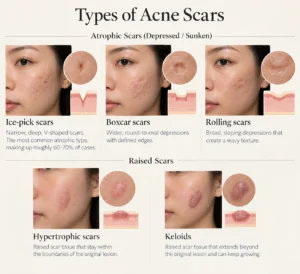
- Ice-pick scars. These are narrow, deep, V-shaped scars. The most common atrophic type, making up roughly 60–70% of cases
- Boxcar scars. These look like wider, round-to-oval depressions with defined edges
- Rolling scars. These are broad, sloping depressions that create a wavy texture
Some scars, instead of being depressed and sunken, are instead raised, and sometimes even fleshy:
- Hypertrophic scars. These are raised scar tissue that stay within the boundaries of the original lesion
- Keloids. These are raised scar tissue that extends beyond the original lesion and can keep growing
Because these scar types behave so differently, “acne scar treatment” isn’t one procedure. For instance, a technique suited to a rolling scar may do little for an ice-pick scar or a keloid.
Acne Marks vs Acne Scars: Key Differences
| Acne Marks | Acne Scars | |
| What is affected | Skin colour | Skin structure/texture |
| Feel | Flat, smooth | Depressed, uneven, or raised |
| Appearance | Red, pink, purple, or brown | Ice-pick, boxcar, rolling, hypertrophic, or keloid |
| Time to recover | Often, over months | Rarely without targeted treatment |
| Treatment goal | Reduce pigmentation/redness | Remodel, lift, smooth, or reduce tissue |
| Typical approach | Topicals, sun protection, acne control | Microneedling, laser, subcision, fillers, or scar-specific procedures |
The quickest self-check: look at the area under angled light, then run a clean fingertip over it. A depression or raised edge will cast a shadow and feel different under your finger. A flat mark won’t, no matter how dark it looks. It’s also common to have both at once, that is pigmentation and textural scarring in the same area, don’t assume treating one will fix the other.
Why Does Acne Leave Marks and Scars?
Inflammation is the common root cause. Once a breakout settles, the skin repairs itself, sometimes leaving only a temporary colour change, but other times leaving deeper collagen damage that becomes a scar. Scarring is more likely with moderate-to-severe and deeper inflammatory acne and that picking or squeezing lesions raises the risk further.
Not everyone scars the same way. Genetics, skin type, acne severity and duration and how a breakout is handled all play a role. This is why the priority is never to wait for scars to appear before addressing the acne causing them.
How Are Acne Marks Treated?
Treating marks means lightening existing pigmentation while preventing new breakouts from creating more. The right combination depends on colour, skin type, and whether acne is still active. Some of the following skincare ingredients have proven to be effective in both lightening marks, and reducing inflammation within active acne lesions, and occasionally I recommend some of them for my patients.
| Ingredient | What it helps with |
| Azelaic acid | Anti-inflammatory; fades dark spots while also treating acne |
| Retinoids (retinol, tretinoin, adapalene) | Improve PIH over time and treat underlying acne |
| Vitamin C | Antioxidant support, brightening |
| Niacinamide | Calms inflammation, improves tone evenness |
| Glycolic / other exfoliating acids | Gentle resurfacing to speed pigment turnover- use with caution |
Word of caution here: more isn’t better. Layering several strong actives at once often irritates skin, and irritation itself can trigger more pigmentation. If you are using a skincare regime to lighten your acne marks, make sure it is simple and easy to follow. A simple, consistent routine outperforms one that changes every two weeks out of impatience.
Daily sunscreen is non-negotiable. UV exposure darkens existing marks and slows healing. While you are getting treatment for your acne marks, make sure you reduce your UV exposure, and use sufficient amounts of sun protection whenever possible.
How Are Acne Scars Treated?
Because scars involve structural change, treatment is more aggressive. The procedures can feel harsher, with more “downtime”. And of course, there’s no single “best” option, as the type of treatment depends on various factors: scar type, depth and skin tone.
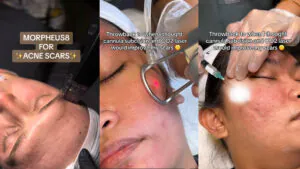
Treatments for Depressed Acne Scars
| Treatment | How it works | Best for |
| Microneedling | Controlled micro-injuries stimulate collagen and elastin | General texture improvement; multiple sessions needed |
| Fractional laser resurfacing | Targeted energy remodels skin as it heals | Rolling and boxcar scars; varies by device and skin type |
| Subcision | A needle releases fibrous bands tethering the scar from below | Rolling scars caused by tethering |
| Dermal fillers | Adds volume beneath the scar to level the surface | Select depressed scars where volume loss is the main issue |
These approaches are often combined, since different scar types need different tools.
Treatments for Raised Acne Scars
Hypertrophic scars and keloids involve excess scar tissue growth, so they need the opposite approach to depressed scars:
- Silicone-based gels or sheets. This is usually the first-line, non-invasive option. These silicone sheets are seldom done as monotherapy, but rather as part of a comprehensive plan.
- Corticosteroid injections. This treatment is effective in reducing excess scar tissue directly. Usually multiple sessions will be required, over 3-6 months.
- Laser treatments. Resurfacing lasers must be used to flatten the scars. Occasionally, pulsed dye lasers or yellow lasers can be used to reduce the colour of the keloids or hypertrophic scars.
Keloids are notably prone to recurring even after treatment, which is why they’re usually managed by a specialist with a longer-term plan rather than a single session.
Can You Prevent Acne Marks and Scars?
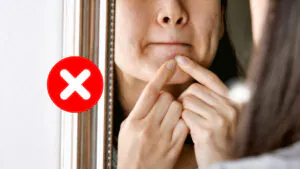
Yes definitely. The most effective strategy is prevention and controlling of the active acne itself, rather than repairing the damage caused by acne inflammation:
- Don’t pick or squeeze the lesions. Mechanical trauma raises inflammation and worsens scarring risk
- Treat acne early. Use ingredients like benzoyl peroxide, salicylic acid, azelaic acid, adapalene, or prescription retinoids
- Wear daily broad-spectrum sunscreen. UV exposure prolongs visible pigmentation, therefore sun protection goes a long way in reducing development of acne marks
When Should You See a Doctor?
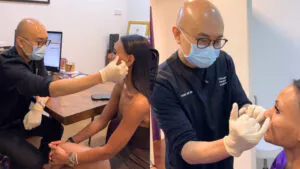
Consider a professional assessment if:
- Dark spots or redness persist despite consistent skincare
- You notice depressions, raised scars, or uneven texture
- Over-the-counter products haven’t produced expected improvement
- You’re considering a procedure like laser resurfacing, subcision, etc to address visible acne scars
Active acne should generally be brought under control before focusing heavily on scar treatment. Scar treatment is rarely a one-session fix, since collagen remodelling takes time. Multiple sessions spanning 4-8 months are not uncommon.
It is also impractical to expect acne scars to disappear completely after a treatment program. The realistic goal is less noticeable scarring and a more even texture, not flawless skin.
Conclusion
The core difference between acne marks and acne scars comes down to colour vs. structure. Marks are flat colour changes that often fade with time, sun protection, and the right topicals. Scars change the skin’s texture, they can appear depressed or raised. And they usually need a targeted procedure matched to the specific scar type.
Start with the basics: control active acne, avoid picking, protect your skin daily, and get a professional opinion when pigmentation or texture changes persist. With the right diagnosis, both problems can be manageable and you can expect them to improve over time.
FAQs
How can I tell if I have an acne mark or an acne scar?
Touch is the fastest test. A flat area of different colour is a mark; a dip, bump, or uneven texture is a scar. Some people have both at once.
Do acne marks disappear on their own?
Often, yes, but it can take months, and deeper pigmentation can last a year or more. Sun protection and consistent skincare speed this up.
Can skincare remove deep acne scars?
No. Skincare can support skin health and help very mild texture changes, but established depressed or raised scars need dedicated procedures like microneedling, laser or subcision.
Is microneedling suitable for all acne scars?
It works best for certain depressed scar types, not raised ones, and suitability depends on active acne status and skin history. A professional assessment is worthwhile before starting.
Should I treat active acne before treating scars?
Yes. New breakouts create new inflammation and potentially new scars, undermining any scar treatment already in progress.
What’s the difference between a pimple mark and a pimple scar?
Same distinction as marks vs. scars generally: a “pimple mark” is a flat colour change, while a “pimple scar” involves a lasting dip or raised area in the skin.
Why do some people scar from acne and others don’t?
It depends on genetics, acne severity and depth, skin type and behaviours like picking. This is why two people with similar breakouts can have very different outcomes.