If you’ve been researching how to get better skin in Singapore, chances are you’ve come across two big names: laser treatments and skin boosters. And if you’ve ever wondered which one is “better”, you’re not alone. But here’s the thing. That might be the wrong question entirely. These two treatments work very differently, target different things, and honestly? They complement each other more than they compete. Let’s break it down in a way that actually makes sense.
First, What Are Skin Boosters Really?
Skin boosters are injectable treatments designed to improve skin quality from within. Unlike fillers that add volume or contour, skin boosters are distributed evenly across the skin to enhance hydration, elasticity, and overall texture.
The category has grown a lot and today, there are actually a few distinct types, each doing something different for your skin.
1. HA (Hyaluronic Acid) Skin Boosters

These are the most well-known and widely used skin boosters.
Hyaluronic acid is a naturally occurring molecule in our skin that binds water. When injected in a soft, spreadable form, it acts as a deep skin hydrator, drawing moisture into the dermis.
The result is skin that appears more hydrated, smoother, subtly plumper, and naturally radiant. Patients often describe this as a ‘dewy’ or ‘glass skin’ effect. Hydrated skin reflects light better, which is what creates that glow.
If you want radiance and hydration, this is your go-to.
2. PN (Polynucleotide) Skin Boosters
@immbunny Salmon DNA REJURAN aka salmon sp*rm is all the rage in the korean skincare world. Main results: healing and protection. Here is my post 1 week check in 🫣 #skincare #kbeauty #rejuran
Unlike HA, PN works at a cellular level by stimulating tissue repair, improving microcirculation, reducing inflammation and promoting collagen production. The improvements are gradual but meaningful. Skin becomes stronger, more resilient, and smoother over time.
They’re especially popular for sensitive skin, acne-prone skin, or anyone whose skin barrier needs some TLC.
3. Hybrid Skin Boosters (HA + PN) – Best of Both Worlds
Can’t decide between instant glow and long-term repair? These newer formulations combine both.
By delivering HA alongside PN, these skin boosters provide immediate hydration while simultaneously stimulating repair and collagen production. The result is a more balanced outcome. Patients see earlier visible improvement compared to PN alone, while still benefiting from deeper skin regeneration.
These are particularly useful for patients who want both radiance and sustained skin improvement.
4. Collagen-Stimulating ‘Skin boosters’ (Light Biostimulators)
@tamsskyn would you try sculptra? #over40 #sculptura #skincare #antiaging #collagen
This last group: think PLA, PDLLA, or diluted calcium hydroxyapatite CaHA, is less about glow and more about structure. They work by stimulating your own fibroblasts to produce collagen and elastin over time. If you’re noticing early skin laxity or loss of firmness, this category is worth knowing about.
So Where Do Lasers Come In?
Lasers take a completely different approach. Instead of working from the inside out, they improve the surface and structure of your skin using controlled energy, correcting damage and triggering your skin’s natural renewal process.
There are two broad types:
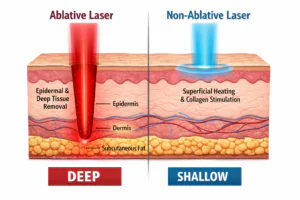
1. Ablative Lasers
Ablative lasers, such as CO₂ or Er:YAG lasers, remove microscopic layers of the skin. They create controlled injuries that stimulate strong collagen regeneration and allow new, smoother skin to replace damaged tissue. These are highly effective for concerns such as acne scars, deep wrinkles, and rough texture.
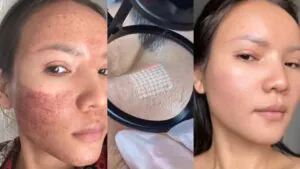
Best for:
- Acne scars
- Rough texture
- Deeper wrinkles
The trade-off? Some downtime – think redness and peeling for several days. But the results? Dramatic.
2. Non-Ablative Lasers
Non-ablative lasers, on the other hand, work beneath the surface without removing the top layer of skin. They are commonly used for pigmentation, redness and overall skin tone improvement. By delivering heat into the dermis, they stimulate mild collagen production while preserving the skin barrier.
Best for:
- Dull skin from uneven tone
- Melasma and sunspots
- Regular maintenance
Changes are more gradual, but your skin gets progressively clearer and brighter over time. Fortunately, this also means less downtime.
The One Thing Lasers Can’t Do
Here’s something worth knowing: lasers are brilliant at making your skin look clearer. But they don’t directly improve hydration or skin quality from within. That dewy, lit-from-within glow? That’s driven by moisture, and that’s not really laser territory.
This is exactly why the two treatments work so well together.
Skin boosters vs Lasers: The Real Difference
Here’s a quick breakdown:
| Feature | Skin boosters | Lasers |
| Core Mechanism | Injectable hydration / regeneration | Energy-based skin renewal |
| Main Function | Improve skin quality from within | Correct surface imperfections |
| Key Benefits | Hydration, glow, elasticity | Pigmentation, tone, texture |
| Types | HA, PN, Hybrid, Light Collagen stimulators | Ablative, Non-ablative |
| Glow Effect | Strong (hydration-driven) | Moderate – Strong (clarity-driven) |
| Collagen Stimulation | Mild to strong (depending on type) | Mild (non-ablative) to strong (ablative) |
| Downtime | Minimal | Minimal to significant (depends on laser) |
| Cost per session (SG) | ~$400 – $1,200+ | ~$150 – $1,200+ |
| Best For | Dull, dry, aging skin | Pigmentation, scars, uneven tone |
| Speed of Results | 1–2 weeks, improves over time | Often faster for visible correction |
| Treatment frequency | Few sessions, spaced out | Multiple sessions required |
| Role in Treatment Plan | Foundation treatment | Corrective/maintenance tool |
So… Lasers or Skin Boosters? Think of it this way:
Skin boosters work from the inside out: improving hydration, elasticity, and the biological health of your skin.
Lasers work from the outside in: correcting tone, texture, and surface clarity.
The “which one is better” debate misses the point. The real question is: what does your skin actually need right now? That’s a conversation worth having with your doctor because the best treatment plan is always the one built around you.
What If You Could Have Both? (Spoiler: You Can)
Let’s talk about what actually gets patients the best results because in clinical practice, it’s rarely just one treatment.
Think about it. Most of us don’t walk in with a single skin concern. Dehydration, pigmentation, and early collagen loss? Those three often show up together. And treating only one of them is a bit like cleaning half the house; technically done, but not quite right.
This is why combination treatments consistently outperform standalone ones. It’s not about doing more for the sake of it. It’s about targeting your skin from every angle.
Embed URL link:
@prettyprogress23 SKIN IS SKINNNINGGGG 🤭❤️ Much brighter plumper skin!!! My second session of this combo seems promising! I feel like my overall texture is so much smoother and lifted. Woohoo 🥳 #pico #rejuran #acnescars
How Lasers and Skin Boosters Work Together
The synergy between skin boosters and lasers lies in how they complement each other.
Lasers remove barriers to good skin – pigment, damaged cells, uneven tone. Skin boosters then restore and enhance the skin from within.
When done correctly, the result is skin that is:
- Clear
- Hydrated
- Smooth
- Naturally radiant
When patients adhere to these treatment programs, the skin benefits are long lasting, requiring only occasional maintenance once a year or so.
Common Real-Life Pairings That Work
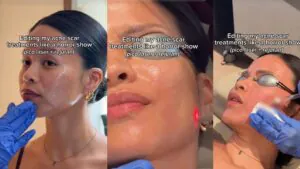
Not all combinations are created equal. Here’s how I would typically approach such cases depending on different skin concerns:
For dull skin with pigmentation:
The most popular pairing in Singapore – non-ablative laser with an HA skin booster. The laser clears and brightens, the skin booster brings back the dewy hydration. Together, that’s your glass skin formula.
For more damaged or scarred skin:
A staged approach works better here. An ablative laser goes in first to resurface and smooth. Once the skin has healed, HA or hybrid skin boosters are introduced to accelerate recovery and elevate overall skin quality.
For early signs of ageing:
Collagen-stimulating injectables paired with laser toning is a favourite for this. The laser keeps skin clear and even, while the injectable quietly rebuilds firmness and elasticity in the background over time.
Timing Matters
Performing treatments too close together, or in the wrong sequence, can reduce effectiveness or increase side effects. For example:
- Skin boosters are usually done after laser treatments, once the skin barrier has had time to settle
- Stronger ablative lasers need a proper recovery window before any injectables are introduced
When combined, lasers and skin boosters can reap huge benefits for the skin. However, we have to keep in mind that a well-designed treatment plan is not just about what treatments are used, but when and how they are layered.
What About Cost and Downtime?
Skin boosters generally involve minimal downtime, with small injection bumps or occasional bruising resolving within a few days. This makes them highly suitable for patients with busy schedules.
Lasers vary more widely. Non-ablative lasers typically have little to no downtime, while ablative lasers require a more significant recovery period.
From a cost perspective, skin boosters and lasers are best viewed as ongoing skin investments rather than one-off treatments. Combination approaches may cost more upfront but often deliver better and more sustained results, reducing the need for frequent corrective treatments later.
So, Which One Is Right for You?
@bellamaddd Replying to @Bella (*´ω`*) here’s how I’m looking so far after Rejuran Healer and Fractional CO2 laser and ngl it looks way worse than it feels 😅 Apart from mild stinging and itchiness I feel normal! #skintreatment #pores #skincare #skincaretiktok #skintok #rejuran #laser
Most patients do not fall neatly into one category. Patients focused on glow and hydration benefit most from HA-based skin boosters. Those with sensitive or damaged skin may benefit from PN-based treatments, while patients concerned with firmness and early laxity may consider collagen-stimulating injectables.
Lasers are more appropriate when the primary concern is pigmentation, uneven tone, or texture issues.
Still not sure? That’s completely normal and honestly, that’s what consultations are for.
Final Thoughts
Lasers vs skin boosters was never really the right question.
Skin boosters improve what your skin is made of. Lasers improve how your skin looks. The most impressive results come from a treatment plan that’s built around your skin, your concerns and your timeline. Healthy skin isn’t a one-treatment destination. But with the right approach, it’s absolutely within reach.
Curious about what combination might work for your skin? We’re happy to walk you through it – no pressure, just an honest conversation about what your skin actually needs.